New Testimonies Point to Moroccan Intelligence Services’ Involvement in Ceuta Incursion
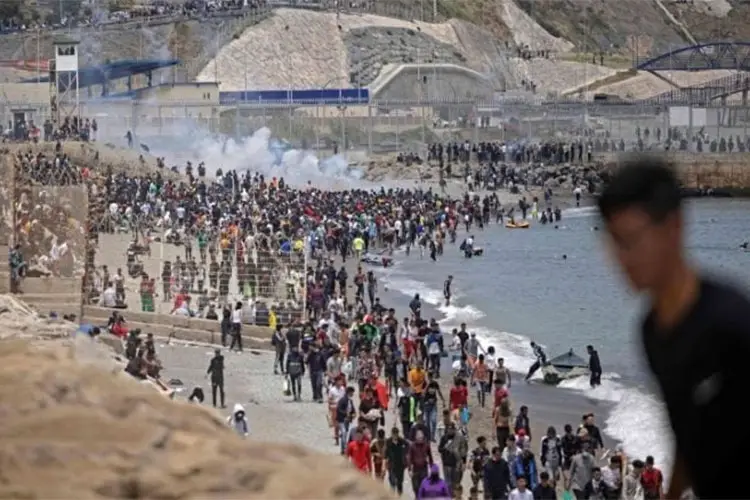
Testimonies given by Spanish police officers before a court in connection with the events in Ceuta have shed new light on the involvement of Moroccan security personnel in directing undocumented Moroccan migrants towards the Spanish enclave. According to the accounts, the movements were not spontaneous but were orchestrated and coordinated from outside Spanish territory, exposing the Moroccan Makhzen regime’s use of migration as an instrument of political pressure and manoeuvring. According to information published on Monday by Spanish newspaper La Razón, Spanish police officers told Judge María Tardón that Moroccan police had been directing undocumented migrants towards Ceuta. They stressed that the events did not constitute a spontaneous influx, but involved clear indications of prior planning and coordination beyond Spain’s borders. The testimonies are particularly significant because they consist of first-hand accounts provided by security officials as part of a judicial investigation. They point to the involvement of Moroccan operatives in actively directing migrant movements towards the border, going beyond mere lax border surveillance or a failure to intervene to prevent crossings. In a related development, Spanish newspaper El Confidencial published a report based on an audio recording of a Spanish police officer’s testimony before the judge. The officer described how Spanish police had come under attack through communications channels during the events, arguing that what had unfolded demonstrated the Makhzen regime’s involvement. The newspaper also ran a separate headline pointing to what it described as Morocco’s “destabilising strategy” towards Ceuta and Melilla. These accounts are consistent with the testimonies concerning the direction of migrants towards Ceuta, shedding further light on the nature of Morocco’s manoeuvres during the crisis. They suggest that the border became the focal point of hostile schemes orchestrated by the Makhzen, which not only failed to fulfil its responsibilities in managing migration flows but also saw its operatives directly involved in pushing migrants towards Spanish territory. Meanwhile, El País has been following the issue of migrants being returned from Ceuta to Morocco, amid the continuing fallout from the mass crossings and the security and judicial measures they triggered. The case highlights the considerable burden placed on the Spanish side by the actions attributed to the Moroccan authorities, leaving Spain to contend with large-scale migrant movements allegedly directed from beyond its borders. For its part, Spanish newspaper ABC reported remarks by People’s Party leader Alberto Núñez Feijóo, who argued that Morocco could not be regarded as a “strategic ally”. He also said he would call for the Constitution to be enforced to allow the deployment of the military along the borders, in order to prevent a recurrence of such events. Taken together, these developments underscore the seriousness of the Makhzen regime’s instrumentalization of irregular migration for hostile political purposes, drawing its own citizens into manoeuvres designed to exert pressure on Spain and turning their hardship and vulnerability into bargaining tools. Such conduct, the reports argue, reflects the Moroccan authorities’ disregard for the principles of good neighbourliness and for the humanitarian and security consequences of their actions.
المصدر: الشروق